
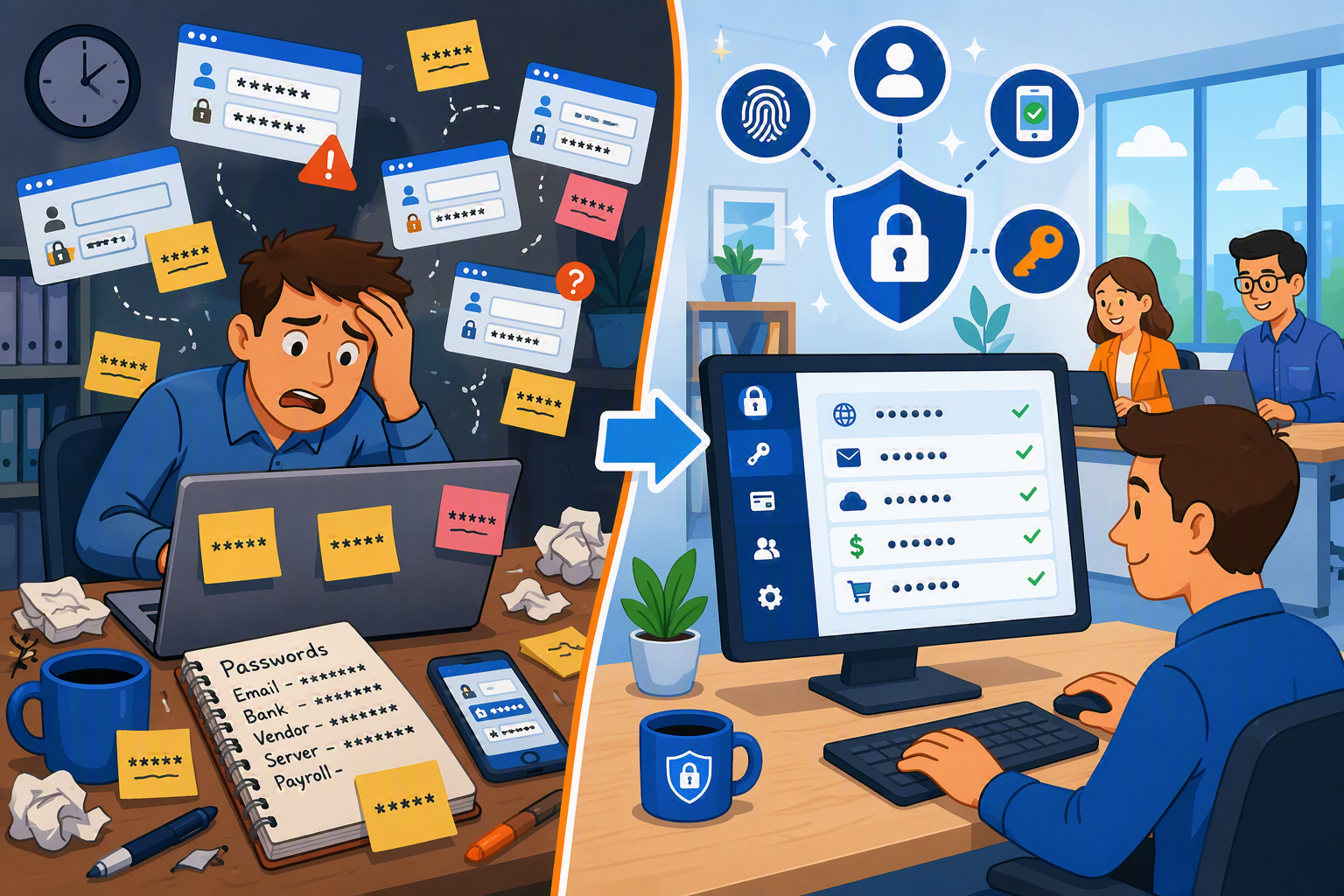
Passwords are frustrating.
Between email accounts, business applications, banking portals, cloud services, vendor websites, and everything else we use every day, it’s nearly impossible to remember dozens—if not hundreds—of unique passwords. Because of that, many people take shortcuts without realizing the risk. Unfortunately, those shortcuts can leave both personal and business accounts vulnerable to cybercriminals.
While newer technologies like passkeys, single sign-on (SSO), and passwordless authentication are becoming more common, passwords are still a reality for most businesses. That’s why password management remains one of the simplest and most effective ways to improve security without making life more difficult for your team.
The Real Risk of Poor Password Habits
Most people don’t intentionally create security risks—they simply choose convenience when password management becomes overwhelming.
Some people keep a list of passwords in a notebook, on a sticky note, or in an unprotected document on their computer. Others reuse the same password across multiple websites and systems to make them easier to remember.
While these shortcuts may seem harmless, they can create serious security concerns. If a cybercriminal gains access to a single password through a phishing email, malware infection, or data breach, they may attempt to use those same credentials elsewhere.
Common Password Mistakes
- Writing passwords down where others can easily find them.
- Reusing passwords across multiple accounts and systems.
- Using simple, predictable passwords that are easier to guess.
- Sharing passwords through email, text messages, or unsecured methods.
Why Businesses Should Care
For businesses, poor password practices can have consequences far beyond a single compromised account.
A stolen password could provide access to company email, cloud applications, business documents, financial systems, or customer information. In many cases, attackers don’t need sophisticated tools—they simply take advantage of weak or reused credentials.
Potential impacts include:
- Business email compromise
- Unauthorized access to company data
- Financial fraud
- Account lockouts
- Downtime and lost productivity
- Damage to customer trust and reputation
A Smarter Approach to Password Security
One of the most effective ways to improve password security is by implementing a password manager.
Password managers securely store credentials and generate strong, unique passwords for every account. Instead of remembering dozens of passwords, users only need to remember one secure master password.
This helps organizations:
- Create strong, unique passwords for every account.
- Reduce password reuse across systems.
- Improve security without sacrificing convenience.
- Share business credentials securely when necessary.
- Quickly update passwords after security incidents.
Additional Security Best Practices
While password managers are a great first step, businesses should also consider additional layers of protection:
- Enable Multi-Factor Authentication (MFA) wherever possible.
- Provide employee security awareness training to help identify phishing attempts.
- Review and update passwords regularly for critical accounts.
- Limit access to sensitive systems based on job responsibilities.
Don’t Let Passwords Become Your Weakest Link
Cybercriminals are always looking for the easiest way into a business. Weak, reused, or poorly managed passwords continue to be one of the most common ways attackers gain access to systems and data.
The good news is that improving password security doesn’t have to be complicated. With the right tools, policies, and employee awareness, businesses can significantly reduce their risk and better protect their operations.
If you’d like help implementing password managers, multi-factor authentication, or other cybersecurity best practices, BOAZ Media & Network Solutions is here to help.